

10 Years of France–Argentina Scientific Collaboration on Tuberculosis/HIV Co-Infection
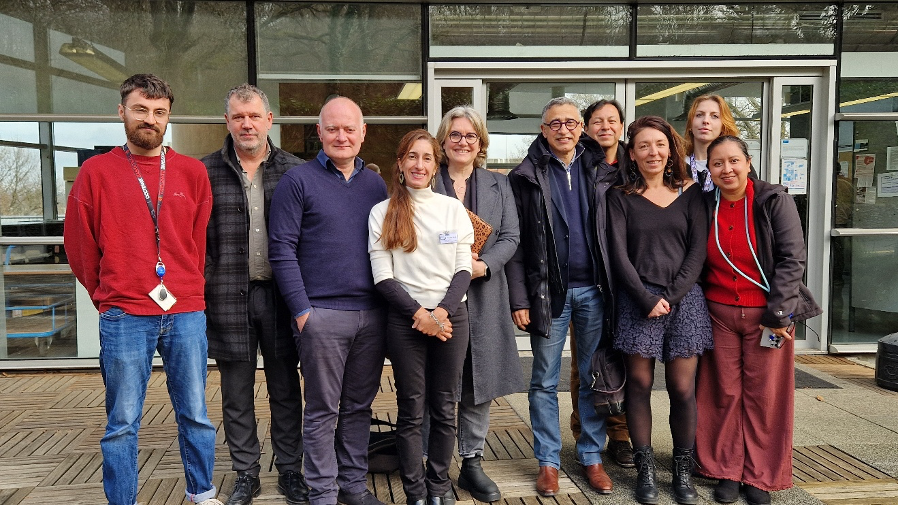
On January 16, 2026, the Institute of Pharmacology and Structural Biology (IPBS) hosted the closing meeting of the France–Argentina MAC-TB/HIV International Research Partnership (IRP). This partnership focuses on the tuberculous microenvironment and susceptibility to HIV-1 infection. During this meeting, the partners reviewed over 10 years of scientific collaboration and discussed future directions.
A Decade of Franco-Argentine Scientific Collaboration
The France–Argentina partnership was launched in 2014 under the ECOS Sud program. Two years later, it was formalized with the creation of the MAC-TB/HIV Laboratoire International Associé (LIA), bringing together IPBS (CNRS–University of Toulouse) and INBIRS (University of Buenos Aires–CONICET).
Funded by CNRS, the LIA was renewed in 2021 as an International Research Project (IRP) for a further five years, strengthening this bilateral cooperation around major global public health challenges.
The January 16 celebration marked ten years of highly successful scientific collaboration, supported by CNRS, CONICET, and the University of Toulouse, and offered an opportunity to reflect on the future direction and scope of the partnership.
The significance of this collaboration was underscored by Richard Guillet, Vice-President for Research at the University of Toulouse, and Abdelhadi Saoudi, Deputy Scientific Director of CNRS Biology, alongside Emmanuelle Trevisol, Deputy Scientific Director of CNRS Biology.
France–Argentina Collaboration at the Heart of a Major Public Health Challenge
Tuberculosis/HIV-1 co-infection remains one of the world’s deadliest infectious threats, affecting an estimated 15 million people and causing around 400,000 deaths each year. Late diagnosis and the harmful synergy between Mycobacterium tuberculosis and HIV-1 place an immense burden on healthcare systems, particularly in South America and Europe.
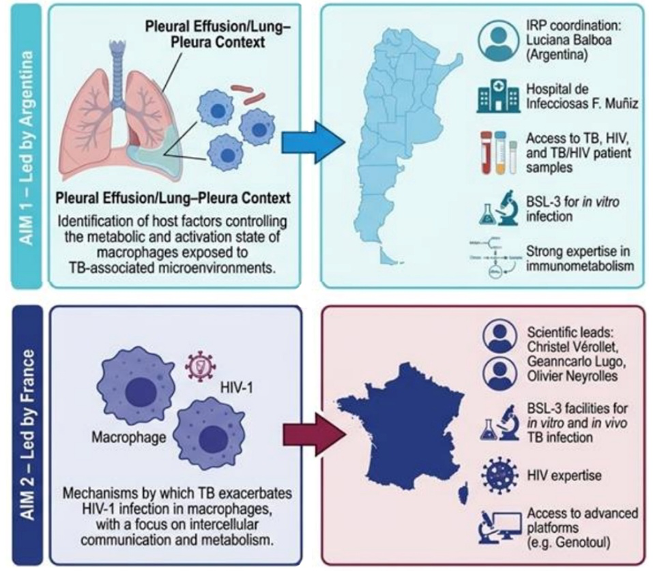
The MAC-TB/HIV laboratory was created to unravel how the tuberculous microenvironment reshapes the metabolic state and activation of human macrophages through dysregulation of lipid networks. These alterations transform macrophages into “Trojan horses,” enabling HIV-1 persistence and dissemination.
A Bilateral Team with Complementary Expertise
To meet this challenge, researchers at IPBS and INBIRS combined their strengths around two main objectives: 1/ To determine how the tuberculous microenvironment modulates macrophage immunity and metabolism; and 2/ To understand how these changes promote HIV-1 propagation.
Key scientific findings were presented by Luciana Balboa, Argentine coordinator of the IRP, in her lecture “Insights from Immunometabolism in Tuberculosis.” On the French side, Christel Verollet, co-coordinator with Geanncarlo Lugo, highlighted their work in “Cell-to-Cell Crosstalk as a Driver of HIV–TB Synergistic Pathogenesis.”
Several other IPBS teams also contributed to the project, including Jérôme Nigou, Émilie Layre, Céline Cougoule, and Étienne Meunier.
Results and Future Perspectives of a Successful Collaboration
The collaboration has resulted in 8 key scientific publications, reinforcing synergy between partners and increasing the project’s international visibility.
Beyond scientific outcomes, it has played a central role in training young researchers, including 6 PhD graduates, 3 current PhD students, and 3 Postdoctoral fellows, who made major contributions through regular exchanges between France and Argentina.
During the closing session, partners discussed the future of the collaboration and expressed their commitment to continue and deepen this scientific partnership in the coming years.
PhD Students and Postdoctoral Fellows Trained
• Current PhD students : Joaquina Barros, Maxime Pingret, Clara Deyts
• PhD graduates : Maeva Dupont, Melanie Genoula, Jose Marin Franco, Rémi Mascarau, Mariano Maio, Sarah Monard
• Postdoctoral fellows : Zoi Vahlas, Leandro Ferrini, Elisabeth Bautista
Key Scientific Publications (2020–2025)
- Dupont M, Souriant S, Balboa L, Vu Manh TP, Pingris K, Rousset S, Cougoule C, Rombouts Y, Poincloux R, Ben Neji M, Allers C, Kaushal D, Kuroda MJ, Benet S, Martinez-Picado J, Izquierdo-Useros N, Sasiain MDC, Maridonneau-Parini I, Neyrolles O, Vérollet C*, Lugo-Villarino G*. Tuberculosis-associated IFN-I induces Siglec-1 on tunneling nanotubes and favors HIV-1 spread in macrophages. Elife. 2020 Mar 30;9:e52535
- Marín Franco JL, Genoula M, Corral D, Duette G, Ferreyra M, Maio M, Belén Dolotowicz M, Aparicio-Trejo OE, Patiño-Martínez E, Charton A, Metais A, Fuentes F, Soldan V, Moraña EJ, Palmero D, Ostrowski M, Schierloh P, Sánchez-Torres C, Hernández-Pando R, Pedraza-Chaverri J, Rombouts Y,Hudrisier D, Layre E, Vérollet C, Maridonneau-Parini I, Neyrolles O, Sasiain MdC, Lugo-Villarino G*, and Balboa L*. Host-derived lipids from pleural effusions of TB patients impair anti-mycobacterial functions in human macrophages though HIF-1α-mediated metabolic reprogramming. Cell Reports,2020 Dec 29;33(13):108547
- Genoula M, JL Marín Franco, M. Maio, B. Dolotowicz, M. Ferreyra, M. Ayelén Milillo, R.Mascarau, Moraña EJ, Palmero D, Matteo M, Fuentes F, López, B, Barrionuevo P, O. Neyrolles, C. Cougoule, G. Lugo-Villarino, Vérollet C, M. del Carmen Sasiain, L. Balboa. Mycobacterium tuberculosis Modulates the Metabolism of Alternatively Activated Macrophages to Promote Foam Cell Formation and Intracellular Survival. PLoS Pathog. 2020 Oct 1;16(10):e100892.
- Cronin S, de Vries-Egan A, Vahlas Z, Czernikier A, Melucci C, Pereyra Gerber P, O’Neil T, Gloss B, Sharabas M, Turk G, Verollet C, Balboa L, Palmer S, Duette G. The immunosuppressive tuberculosis-associated microenvironment inhibits viral replication and promotes HIV-1 latency in CD4+ T cells. iScience. 2024 Jun 20;27(7):110324
- Maio M, Joly M, Vahlas Z, Barros J, Marín Franco J, Genoula M, Monard S, Vecchione M, Fuentes F, Polo Virginia G, Quiroga M, Vermeulen M, Argüello RJ, Inwentarz S, Musella R, Ciallella L, Montaner P González, Palmero D, Lugo-Villarino G, del Carmen Sasiain M, Neyrolles O, Verollet C*, Balboa L*,#.Elevated glycolytic metabolism of monocytes limits the generation of HIF-1α-driven migratory dendritic cells in tuberculosis. Elife. 2024, Jun 26;12:RP89319
- Bénard A, Balboa L, Fillatreau S, Sasiain MC, Neyrolles O, Hudrisier D. Human IL-6-producing B cells promote the differentiation of monocytes towards an anti-inflammatory M2-like phenotype in tuberculosis. Eur J Immunol 2025
- 2 upcoming publications