The Werner protein, guardian of the genome: a helping hand for its repair function
A recent discovery sheds new light on the mechanisms underlying Werner syndrome, a rare disorder that causes accelerated ageing, and could open up new avenues for targeting certain cancers. The results of an international collaboration between French, Swiss, Italian and British teams reveal, at the atomic level, how the two DNA repair proteins Ku and WRN assemble and work together. This discovery was published on May 13 in Nature Communications.
Every day, the DNA in our cells sustains damage caused by radiation, chemical stress or copying errors. To deal with this, they have an arsenal of repair proteins at their disposal. Among these, the WRN (Werner) protein plays a role in repairing damaged DNA strands. When the gene encoding WRN is mutated, it causes Werner syndrome, a rare condition characterised by premature ageing and a high predisposition to cancer.
Researchers already knew that WRN does not work alone: another protein, called Ku, binds to DNA breaks and stimulates WRN’s activity. But it was not known precisely how these two proteins assemble, nor why this association makes WRN more effective.
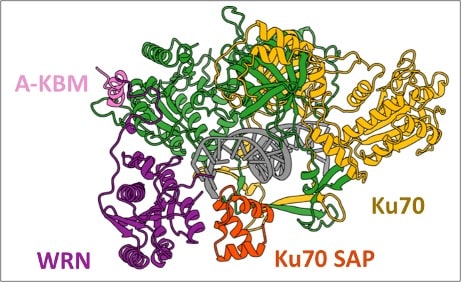
Using cryo-electron microscopy, the international team was able to visualise for the first time the exact structure of the complex formed by Ku, a part of WRN and a fragment of DNA. The result is a three-dimensional map of their interaction, revealing several precise contact points between the two proteins. In particular, a small region of Ku, known as the SAP domain, stabilises the entire complex and allows WRN to be positioned exactly in the right place on the DNA. Without this contact, WRN remains present but loses much of its effectiveness.
To validate their structural observations, the researchers introduced targeted point mutations at the contact interfaces between the two proteins, and then analysed the consequences in living human cells. By inducing DNA damage with a laser and tracking the fluorescent proteins in real time, they demonstrated that the removal of either of these contact points prevented the effective recruitment of WRN to the damaged sites.
When the DNA replication machinery stalls on an obstacle, replication forks can collapse, exposing DNA fragments that risk being degraded in a disorderly manner. The study also shows that WRN, guided by Ku, protects these stalled forks from aberrant degradation. Without the intact Ku-WRN interaction, this protection is lost and genome integrity is compromised.
A better understanding of how WRN is activated should help explain the abnormalities observed in Werner syndrome. In oncology, WRN is already a therapeutic target of interest in so-called microsatellite instability tumours, which depend on WRN to replicate. A precise understanding of Ku-WRN interactions could enable the design of molecules capable of interfering with WRN’s activities in tumour cells.
Reference : Sayma Zahid#, Jeanne Chauvat#, Ilaria Ceppi#, Floriana Cappiello#, Benedetta Perdichizzi#, Philippe Frit, Dennis Gomez, Steven Hardwick, Pierre Legrand, Julien Karazi, Sonia Baconnais, Gerard Pehau-Arnaudet, Sebastien Britton, Jean-Baptiste Charbonnier, Amanda Chaplin*, Pietro Pichierri*, Petr Cejka*, Patrick Calsou* and Virginie Ropars*. (2026) Structural basis of Ku-mediated activation of WRN exonuclease activity. Nature communications DOI: 10.1038/s41467-026-71888-w
Contact : Patrick Calsou (Patrick.Calsou@ipbs.fr) or Sébastien Britton (Sebastien.Britton@ipbs.fr)
The Werner protein, guardian of the genome: a helping hand for its repair function