

A new type of anucleate fat cell involved in blood cell production discovered in human bone marrow
Long considered a passive structural component, bone marrow adipose tissue is now emerging as a key component of the bone marrow microenvironment. Yet its physiological functions remain largely unexplored. A research team has now identified a previously unknown type of adipocyte in human red bone marrow: cells that lack a nucleus but remain metabolically active and capable of supporting hematopoiesis—the process by which blood cells are produced.
This discovery represents a remarkable finding in cell biology. Among eukaryotes, anucleate cells are exceedingly rare, and in humans this feature has been considered largely restricted to highly specialized blood components such as red blood cells and platelets. Published in Cell Reports, this study reveals the existence of an unexpected subtype of adipocyte that remains functional despite the absence of a nucleus and plays an active role within the hematopoietic niche.
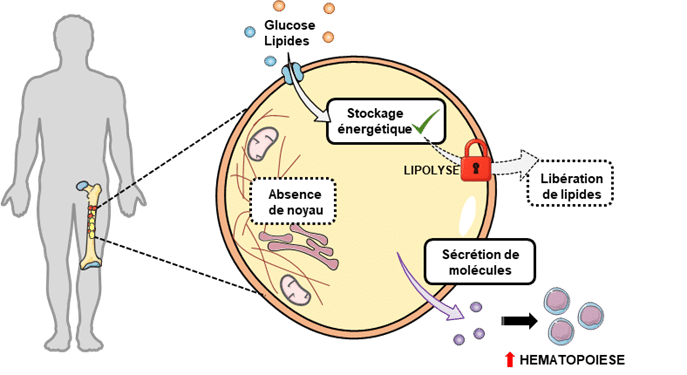
Anucleate but Active Adipocytes in Human Bone Marrow. Human bone marrow adipocytes in red bone marrow lack a nucleus but remain metabolically active. They store energy in the form of glucose and lipids but are unable to efficiently mobilize these reserves through lipolysis during caloric restriction. Instead, they secrete soluble factors that promote hematopoiesis—the production of blood cells. @Camille Attané
A new type of adipocyte in human bone marrow
Red bone marrow is the primary site of blood cell production. It also contains large numbers of fat cells, known as bone marrow adipocytes, whose physiological role remains poorly understood. Until now, research on these cells has relied mainly on animal models, in which their limited abundance has hampered detailed characterization. Using an optimized bone marrow aspiration protocol previously developed by the team, the researchers were able, for the first time, to isolate human red bone marrow adipocytes in sufficient quantities for comprehensive analysis.
By combining advanced imaging, cellular analyses, and molecular biology approaches, they uncovered a completely unexpected feature: these adipocytes are anucleate, meaning they lack a nucleus. Nevertheless, they retain other intracellular organelles, including mitochondria and endoplasmic reticulum, suggesting that they maintain an organized and functional cellular metabolism.
Anucleate cells that remain fully functional
Despite the absence of a nucleus, these bone marrow adipocytes preserve several metabolic functions characteristic of conventional adipocytes, particularly those involved in lipid and glucose metabolism. However, they appear unable to mobilize their lipid stores in response to caloric restriction through the process of lipolysis. This distinctive feature may reflect a specialized physiological role: rather than serving primarily as a readily mobilizable energy reserve, these cells may be preserved to fulfill essential functions within the bone marrow niche.
Indeed, the researchers found that these adipocytes exhibit robust secretory activity, releasing numerous soluble factors involved in hematopoiesis. In culture, they directly support the proliferation and differentiation of hematopoietic stem and progenitor cells. These findings demonstrate that human bone marrow adipocytes are far more than passive space-filling cells; they are active components of the bone marrow microenvironment that help regulate blood cell production.
A discovery with major implications
This study reveals the unexpected existence of a functional, anucleate adipocyte in human bone marrow. It demonstrates that a eukaryotic cell can not only survive without a nucleus but also maintain metabolic activity, produce biologically active factors, and contribute to the function of an essential tissue.
Beyond the cellular observation itself, these findings fundamentally reshape our understanding of bone marrow adipose tissue. They reveal an unexpected level of functional complexity within human red bone marrow and open new avenues for investigating how the bone marrow microenvironment regulates hematopoiesis under physiological conditions, as well as in pathological settings such as aging, hematological disorders, and bone marrow cancers.
This work, conducted at the Institute of Pharmacology and Structural Biology (CNRS/University of Toulouse), was carried out in collaboration with the Department of Orthopaedic and Trauma Surgery (Pierre-Paul Riquet Hospital, Toulouse University Hospital), the RESTORE Institute (Inserm/CNRS/University of Toulouse), the Toulouse Cancer Research Center, and the Institute of Metabolic and Cardiovascular Diseases (Inserm/University of Toulouse). The study was supported by funding from the French National Cancer Institute (INCa) and the French National League Against Cancer (IPBS team accredited by the Ligue Nationale contre le Cancer).
Reference: Red bone marrow hosts metabolically active anucleate adipocytes that support hematopoiesis Sauyeun Shin, Marine Hernandez, Stéphanie Dauvillier, Manuelle Ducoux-Petit, Emmanuelle Mouton-Barbosa, David Estève, Mohamed Moutahir, David Rengel, Océane Delos, Mathieu Roumiguié, Cédric Dray, Philippe Valet, Philippe De Médina, Marc Poirot, Sandrine Silvente-Poirot, Justine Bertrand-Michel, Odile Burlet-Schiltz, Nicolas Reina, Catherine Muller and Camille Attané Cell Reports, DOI : 10.1016/j.celrep.2026.117602
Researchers: Dr Camille Attané (Camille.Attane@ipbs.fr) or Pr Catherine Muller (Catherine.Muller@ipbs.fr), Institut de Pharmacologie et de Biologie Structurale, UMR 5089, CNRS/Université de Toulouse, 205 route de Narbonne 31400 Toulouse
Press IPBS: Françoise Viala | Communication@ipbs.fr | 06 01 26 52 59