

Tuberculosis: how the bacterium expels toxic metals to resist the immune system
The tuberculosis bacillus survives inside immune cells by neutralizing toxic metals such as zinc. A study published in the EMBO Journal reveals a previously unknown mechanism: the assembly of “effluxosomes,” dynamic membrane platforms that group together several molecular pumps which expel various metals out of the bacterium. These findings shed light on the bacillus’s physiology and could inspire new treatments targeting these structures.
Membrane platforms to escape destruction
When the tuberculosis bacillus, Mycobacterium tuberculosis, infects a host, it is rapidly phagocytosed by macrophages—immune cells responsible for eliminating it. Among their defense strategies, these cells use toxic metals such as zinc, copper, and possibly cadmium to poison the pathogen. Yet M. tuberculosis manages to withstand these attacks thanks to a sophisticated molecular mechanism.
Scientists have identified three proteins—PacL1, PacL2, and PacL3—that play a central role in organizing the bacterial membrane. PacL1 acts as a true “metal shuttle”: it can bind zinc, cadmium, and copper through a specific motif located at its end, thereby facilitating their transfer to specialized membrane pumps. PacL2 and PacL3, in turn, stabilize these pumps and promote their clustering into functional groups, forming efficient extrusion platforms known as effluxosomes.
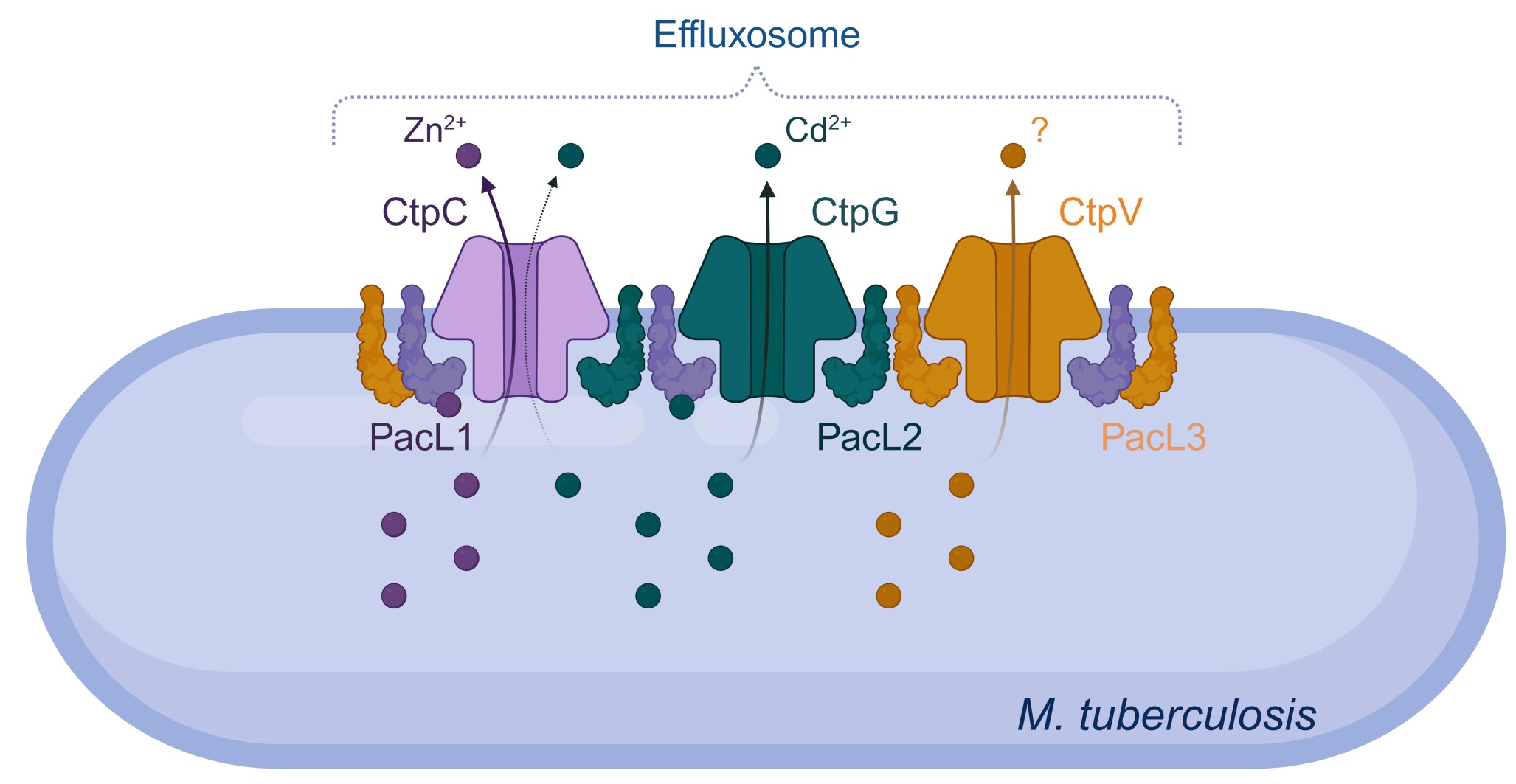
Figure: Conceptual model of the mycobacterial effluxosome for cross-metal resistance
The P-ATPases CtpC and CtpG facilitate the expulsion of zinc and cadmium from the cell, while the role of CtpV remains poorly understood. The proteins PacL1, PacL2, and PacL3 interact with each other through a GXXG motif in their transmembrane domains, and with the N-terminal metal-binding domains of CtpC, CtpG, and CtpV via EA repeat sequences in their cytoplasmic domains. These interactions are essential for P-ATPase–mediated metal resistance and for their assembly into mobile, dynamic membrane complexes. Unlike PacL2, PacL1 binds a variety of metal ions, thereby enhancing the metal tolerance conferred by the P-ATPases. © Pierre Dupuy
A dynamic and hierarchical organization
In a study published in the EMBO Journal, scientists combined genetic, biochemical, and advanced microscopy approaches to characterize these structures.
Using super-resolution microscopy, including PALM and sptPALM techniques, they were able to visualize in real time the formation, distribution, and mobility of effluxosomes in the bacterial membrane.
These observations reveal a dynamic and hierarchical organization. Some PacL proteins form stable clusters anchored in the bacterial membrane, while others are mobile: they move rapidly within the membrane to capture toxic metals and deliver them to the pumps. This organization allows the bacterium to respond quickly to fluctuations in metal concentrations, optimizing its survival in a hostile environment.
A new therapeutic target against resistance
The implications of this discovery are significant in the fight against tuberculosis, a disease that remains a global scourge, causing 1.5 million deaths per year. Management is further complicated by the increasing prevalence of M. tuberculosis strains resistant to conventional antibiotics, requiring long, costly, and often toxic treatments.
By targeting effluxosomes, it may be possible to weaken the bacterium’s resistance to toxic metals, making it more vulnerable to immune defenses or existing antibiotics. “Understanding how M. tuberculosis hijacks toxic metals to survive gives us precise and innovative targets,” emphasizes Pierre Dupuy, first author of the study. “By targeting effluxosomes, we could develop treatments that render the bacterium vulnerable, even when it is resistant to antibiotic therapies.”
Reference: Dupuy, P., Boudehen, YM., Faucher, M. et al. Membrane-associated effluxosomes coordinate multi-metal resistance in Mycobacterium tuberculosis. EMBO J (2026). https://doi.org/10.1038/s44318-026-00715-1
Contact Scientists: Pierre.Dupuy@ipbs.fr ; Olivier.Neyrolles@ipbs.fr
Contact IPBS: Communication@ipbs.fr