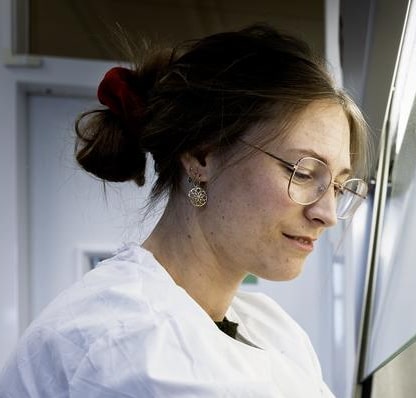
Virginie Stévenin awarded an ATIP-Avenir grant to study how intracellular bacteria feed inside human cells
Virginie Stévenin has been awarded an ATIP-Avenir grant, which will support for five years the research of her team, Cell Infection Dynamics, at the Institute of Pharmacology and Structural Biology (IPBS, CNRS/University of Toulouse). This highly competitive programme will enable her to develop an ambitious research project dedicated to intracellular bacterial infections.
Virginie Stévenin obtained her PhD from University Paris Diderot, working at Institut Pasteur in the laboratory of Jost Enninga, where she studied the cellular mechanisms underlying Salmonella invasion and intracellular trafficking. She then joined the laboratory of Jacques Neefjes at Leiden University Medical Center, where she further developed her expertise in host–pathogen interactions, cellular imaging, intracellular membrane trafficking and bacterial manipulation of host-cell pathways. Her work has contributed to major advances in our understanding of how Salmonella establishes its intracellular niche and remodels infected cells, leading to publications in journals including Cell Reports, Nature Protocols, Cell Chemical Biology, Cell ReportsMedicine and Nature Reviews Cancer. She has also obtained several competitive grants, including a VENI grant from the Dutch Research Council and an FRM Starting Grant for Young Research Teams.
Some pathogenic bacteria, such as Salmonella, are able to enter human cells and multiply inside a membrane-bound compartment called a vacuole. Far from being a passive structure, this vacuole is actively remodelled by the bacterium, allowing it to escape immune defences and create a protected niche. To survive and proliferate in this confined environment, however, Salmonella must gain access to nutrients provided by the host cell — a process whose underlying mechanisms remain poorly understood. Virginie Stévenin’s ATIP-Avenir project aims to determine how Salmonella hijacks host-cell transport proteins to direct nutrients towards the bacterial vacuole and support intracellular replication. Her team will identify which nutrients are delivered to the vacuole, decipher how host transport pathways are redirected during infection, and establish why this process is essential for bacterial growth inside human cells. Salmonella is responsible for intestinal infections that can be severe, and antibiotic-resistant salmonellae are listed by the World Health Organization among priority bacterial pathogens. The strategy of replication within a vacuole is also shared by other major intracellular pathogens, including Mycobacterium tuberculosis, the causative agent of tuberculosis, and Chlamydia trachomatis, responsible for sexually transmitted infections. By revealing how intracellular bacteria obtain nutrients from their host cells, this research will provide new insight into a fundamental aspect of infection biology and may open the way to therapeutic strategies designed to starve pathogens inside infected cells.
Created through a partnership between Inserm and CNRS, the ATIP-Avenir program allows around twenty young researchers each year to establish their own research team in the fields of life and health sciences. To date, the program has supported more than 400 promising scientists. Originally launched in 1990 and 2000 respectively, and merged in 2009, the ATIP (Action Thématique Incitative sur Programme) program of the CNRS Institute of Biological Sciences and the Avenir program of Inserm help young researchers set up independent teams in the life and health sciences. The program also aims to promote researcher mobility and attract young talent to French laboratories.
Virginie Stévenin awarded an ATIP-Avenir grant to study how intracellular bacteria feed inside human cells