
Since January 2024, the Institute of Pharmacology and Structural Biology (IPBS), represented by the Microenvironment, Cancer and Adipocytes team, has been a partner in the European doctoral network PROSTAMET, funded by the European Commission’s Horizon Europe programme under the Marie Skłodowska-Curie Actions.
This network has established an innovative research program involving 9 PhD students working on interconnected projects, with the aim of improving prostate cancer management.
The network brings together 8 partners and 8 associated partners from both the academic and private sectors across 6 European countries: Belgium, France, Italy, Portugal, Germany and the United Kingdom.
At IPBS, Alessandro Taccini was recruited as a doctoral candidate within the Microenvironment, Cancer and Adipocytes team led by Catherine Muller for three-years.
Under the supervision of Camille Attané and Catherine Muller, his project aims to investigate the metabolic symbiosis between bone marrow adipocytes and prostate cancer cells, as well as its role in the progression of bone metastases.
Alessandro’s work is part of a broader set of 9 interconnected PhD projects ranging from advanced spatial mapping of lipid metabolism alterations in prostate cancer to the development of biomarkers and therapeutic strategies with the aim of improving patient care.
One of the key strengths of this network is its ability to provide the 9 recruited doctoral candidates with high-level training while fostering exchanges between partners.
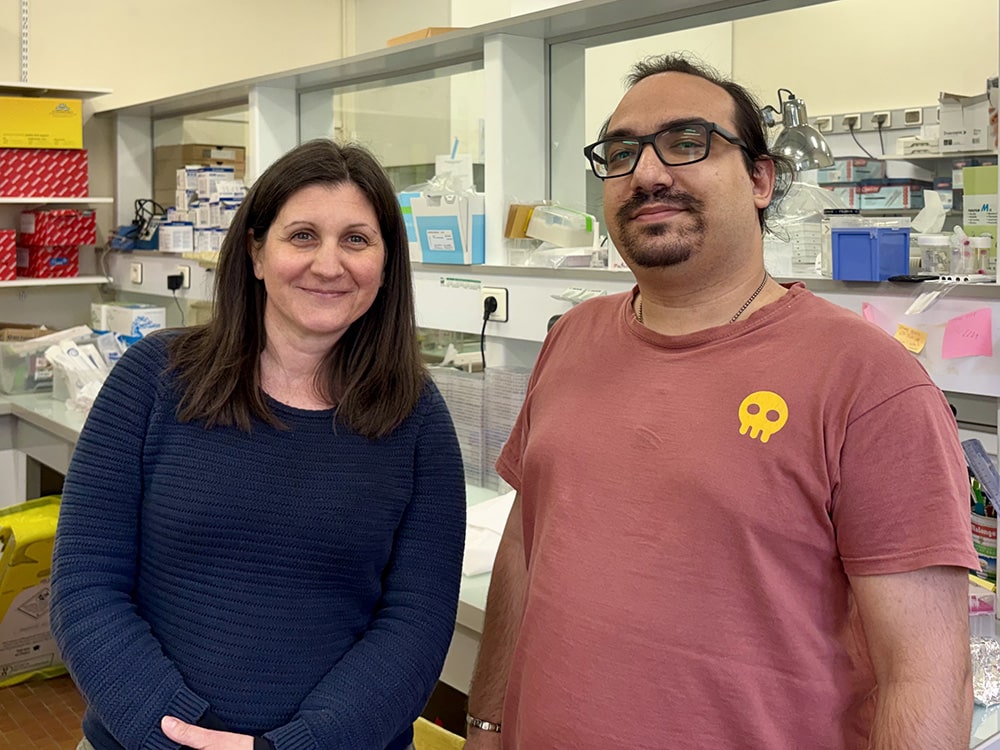
Suraj Narayanan Chembukavu, a PhD student at Université Côte d’Azur under the supervision of Frédéric Bost, joined IPBS in February 2026 for a two-month secondment.
His project aims to investigate the molecular links between prostate cancer progression and lipid homeostasis imbalance.
This mobility period at IPBS enabled him to benefit from the expertise of Catherine Muller’s team, particularly in co-culture approaches involving prostate tumour cells and adipocytes.
Similarly, Alessandro Taccini spent one month in June at the Leuven university (Belgium) in Johan Swinnen’s laboratory to receive training in lipid analysis by mass spectrometry. He will also travel to Université Côte d’Azur next September 2026 to benefit from the expertise of Frédéric Bost’s team in prostate organoid culture.
Beyond mobility opportunities, the doctoral candidates benefit from a comprehensive training programme including Journal Clubs, conferences and symposia, the organisation of Summer and Winter Schools, the development of transferable skills (communication, scientific dissemination, ethics, open science, scientific integrity, etc.), as well as career development support.
This network is part of the Marie Skłodowska-Curie Actions, the European Union’s reference programme for doctoral education and postdoctoral training. The year 2026 marks a key milestone: the 30th anniversary of the Marie Skłodowska-Curie Actions.
This programme has been a cornerstone of European research and a symbol of excellence, fostering mobility across disciplines, sectors and countries, while attracting and training top-level talent.
This project has received funding from the European Union’s Horizon Europe research and innovation programme.
Views and opinions expressed are however those of the author(s) only and do not necessarily reflect those of the European Union or European Commission. Neither the European Union nor the European Commission can be held responsible for them.