

PA200: A protein that reprograms the immunoproteasome and its activity
The immunoproteasome degrades cellular proteins to generate peptides, including those presented to immune system cells. In a study published in Nature Communications, scientists demonstrate that the PA200 protein alters both its structure and enzymatic activity. These findings reveal a new level of regulation for this machinery, which is essential for cellular immunity.
The Immunoproteasome: A core machinery in immune surveillance
The proteasome is a molecular complex responsible for degrading unnecessary, damaged, or misfolded proteins. This recycling system plays a vital role in maintaining cellular balance.
In immune cells or during inflammation, certain proteasome subunits are replaced to form a specialized version: the immunoproteasome. This variant helps produce peptides that are presented on the cell surface by MHC class I molecules (CMH-I), enabling CD8+ T lymphocytes to recognize and eliminate infected or cancerous cells.
The activity of the immunoproteasome itself is controlled by various regulatory proteins. Among them, PA200 remains poorly understood, despite its involvement in numerous processes, including cancer, aging, DNA repair, and cellular stress responses.
PA200 deforms the immunoproteasome structure
Using a combination of high-resolution cryo-electron microscopy, proteomics, mass photometry, and cellular analyses, scientists have uncovered a previously unknown regulatory mechanism.
Structural analysis of complexes formed by PA200 and the immunoproteasome reveals that the binding of a single PA200 molecule causes the entire immunoproteasome to bend. This deformation propagates along the complex via an allosteric mechanism: PA200 binding at one end induces structural changes at a distance, reaching the opposite end.
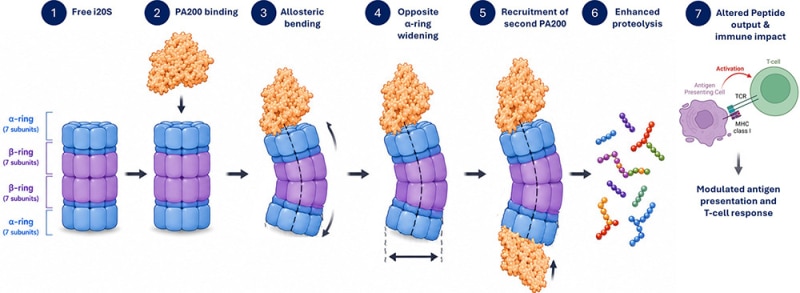
The interaction between the free immunoproteasome (1) and the PA200 regulator (2) induces a long-distance allosteric change that slightly bends the barrel-like structure of the i20S (3) and alters the surface of the opposite alpha ring (4). This stabilizes the binding of a second PA200 molecule (5). This unique interaction enhances enzymatic activity (6) and modifies the generated peptides (7), potentially affecting the peptides presented to T lymphocytes and, consequently, the immune response.
These changes widen the ring at the second end, facilitating the binding of another PA200 molecule. This promotes the formation of complexes with PA200 at both ends. Notably, this phenomenon is not observed with the standard proteasome, indicating that PA200 acts differently depending on the type of proteasome it associates with.
A profound remodeling of enzymatic activity
This structural reorganization is accompanied by a significant alteration in immunoproteasome function. PA200 strongly enhances the activity of all three catalytic sites, which are responsible for protein degradation. However, its effect goes beyond a simple increase in activity.
Proteomic analyses show that PA200 association changes how the immunoproteasome cleaves proteins, leading to the production of a greater number of peptides and favoring specific cleavages corresponding to “caspase-like” activity.
Thus, PA200 can modify both the quantity and nature of peptides produced by the immunoproteasome. This is a critical finding, as some of these peptides are destined for presentation to T lymphocytes: altering their production could influence the repertoire of antigens recognized by the immune system.
A new player in immune regulation
The study also suggests that PA200 may influence the very composition of the immunoproteasome. In its absence, the expression of β1i/PSMB9—one of the catalytic subunits characteristic of the immunoproteasome—decreases. Therefore, PA200 may act not only on the activity of this machinery but also on its formation.
Additionally, analysis of various tissues and cellular models reveals that PA200 expression does not always correlate with that of immunoproteasome components. Their regulation follows distinct mechanisms depending on the tissue and physiological or inflammatory conditions. The interaction between PA200 and the immunoproteasome thus represents a finer level of control over antigenic peptide production than previously thought.
These results provide new insights into how cells regulate the peptides presented to the immune system. Since the immunoproteasome plays a key role in responses against infected or cancerous cells, a better understanding of PA200’s action could, in the long term, help explore new strategies to modulate immune responses, particularly in the context of cancer or inflammatory diseases.
Reference: Živković D, Bosc-Rosati A, Dafun AS, Mourtada F, Grygier P, Yazgili AS, Jansma M, Rawski M, Czarna A, Bohn S, Zak KM, Santos Dias Mourão A, Reiling N, Zemke L, Guo K, Behr J, Burlet-Schiltz O, Popowicz GM, Marcoux J, Meiners S, Bousquet MP. PA200 modulates immunoproteasome structure and activity. Nat Commun. 2026 Aug 11;17(1):8175. doi: 10.1038/s41467-026-75325-w
Contact:
Communication@ipbs.fr
Researchers: Marie-Pierre.Bousquet@ipbs.fr | Julien.Marcoux@ipbs.fr